Street Life: The “Cries” in British Visual Culture, 1711-1877
The Criers
One of the best-known publications of the European Cries genre was the Cryes of the City of London Drawne after the Life consisting of seventy-four images engraved and published by Pierce Tempest in 1687 after designs drawn by the Dutch, London-based artist Marcellus Laroon. The Cries prints had hitherto taken the form of broadsheets of multiple figures, and Laroon’s sequence of single plates was novel. Priced at one-half guinea, the publication was produced for specialist print collectors rather than for the more popular market for which Cries prints hitherto had been intended. It was instantly successful, and until 1733 the engravings were reprinted regularly, with cheap pirated versions of the images circulating widely.
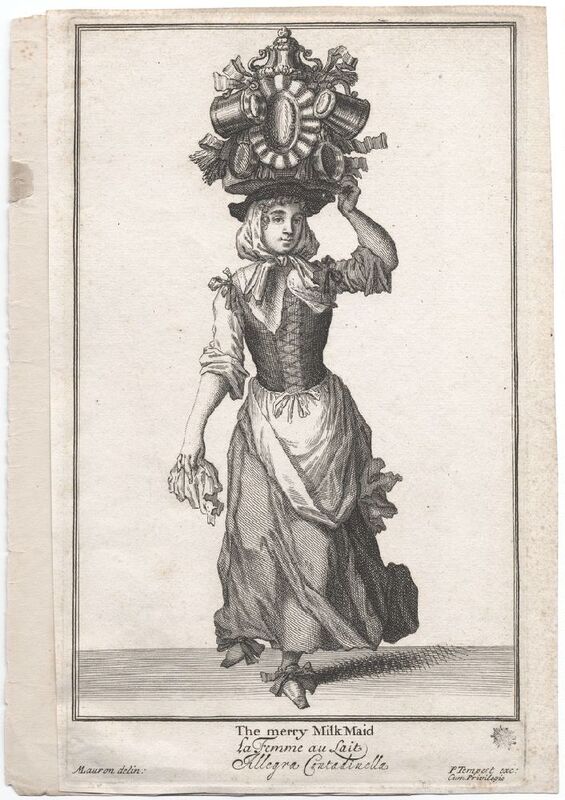
Pierce Tempest (1653–1717) after Marcellus Laroon (1653–1702). Merry Milk Maid, 1733. Engraving. London: Henry Overton. The Lewis Walpole Library, 733.00.00.41
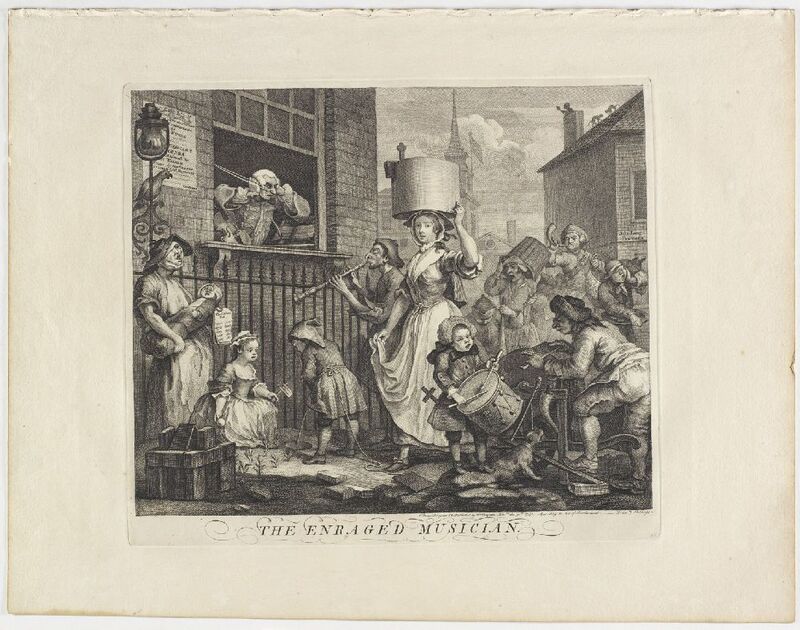
William Hogarth (1697–1764). The Enraged Musician, 1741. Engraving. London: William Hogarth. The Lewis Walpole Library, Sotheby 30++ Box 305
The prints were inscribed with texts that either indicated the profession of the figures or rendered their cries in English, French, and Italian, thereby emphasizing the project’s cosmopolitanism. Each figure is depicted in a negative space, like an actor on a stage, and could have been located on the streets of any European city. Despite the standard claim that the images were “drawne after the life,” many of the figures are closer to masquerade characters than everyday street figures. The milkmaid is depicted not in working attire, but adorned with the elaborate headdress traditionally worn by members of her profession during the annual May Day parades in London. Laroon’s prints were both admired and critiqued by artists. The painter and engraver William Hogarth, who presented himself as staunchly patriotic to the point of xenophobia, famously appropriated Laroon’s figures to populate his engraving of The Enraged Musician, contrasting British robustness with effete Continental manners and cultural practices. On a London street, a foreign (likely French) violinist is maddened by the din of vulgar street noise. A ballad singer, a fishmonger, and a milkmaid cry their wares, a baby wails, a girl shakes her wooden-rachet rattle, a boy beats a drum, one man blows into his hautboy (oboe), another his horn, parrots and cats screech, and church bells ring. The sturdy milkmaid is, unlike Laroon’s, dressed in everyday garb and bears an improbably weighty milk can on her head.
Street cries evolved because the pitched singing voice projects well without taxing the vocal cords in the way shouting does. The Cries images encapsulate all five senses—sight, sound, touch, smell, and taste—and communicate the overwhelming sensorial experience of moving through crowded city streets. The eighteenth-century British poet and playwright John Gay evoked these encounters vividly in his poem, Trivia (Latin, “the crossroads”). The poem re-created the experience of walking through the metropolis in different seasons of the year, though the reality of street life was far less glamorous than it suggests.
Who were the street vendors and what did they sell? Inscriptions on engraved images of criers routinely claim that they were “taken from the life.” This insistence on the immediacy of artistic observation was a convention in the eighteenth and nineteenth centuries but, in practice, many of the figures were directly borrowed from Marcellus Laroon, and most were aestheticized. Vendors were often presented as elegantly dressed and picturesque, though some artists, notably William Hogarth and Paul Sandby, pushed back against such artificiality by depicting their food sellers as wearing everyday, sometimes ragged, garments that are much closer to attire typically worn by those who sold odoriferous and messy foods on the streets in all weathers.
Some vendors earned decent wages, but many struggled to make a living and endured precarious existences, living in substandard rental accommodations or on the streets. Commerce in London operated then, as it does today, as a gig economy, and many street vendors worked more than one job, combining hawking with occupations such as cleaning, domestic service, laboring, and prostitution. Children as young as seven worked as vendors’ assistants until 1834, when the New Poor Law was passed. Women street sellers were often denigrated, and misogynistic stereotypes, including the unattractive bawling fishwife and lascivious oyster girl, were embedded in the genre.
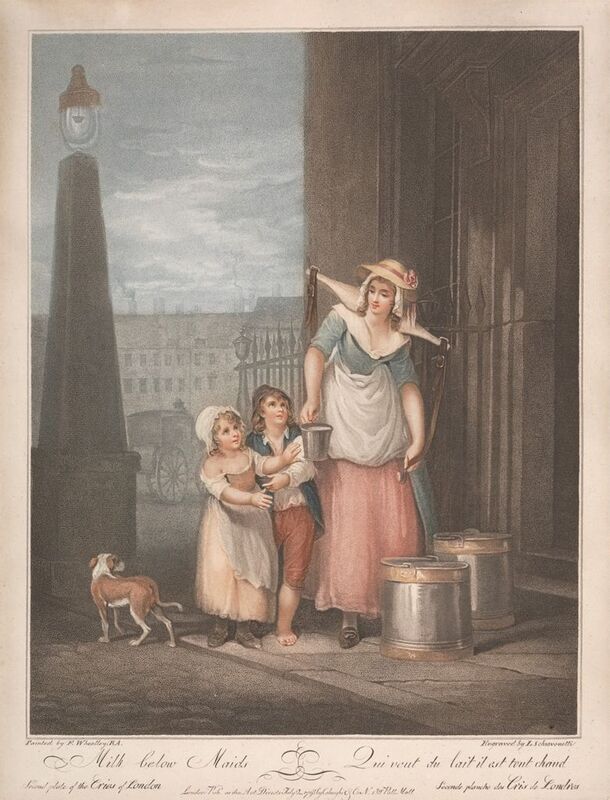
Luigi Schiavonetti (1765-1810) after Francis Wheatley (1747-1801). Milk Below Maids, 1793. Color printed etching. London: Colnaghi. Yale Center for British Art, Paul Mellon Collection, B1974.12.3
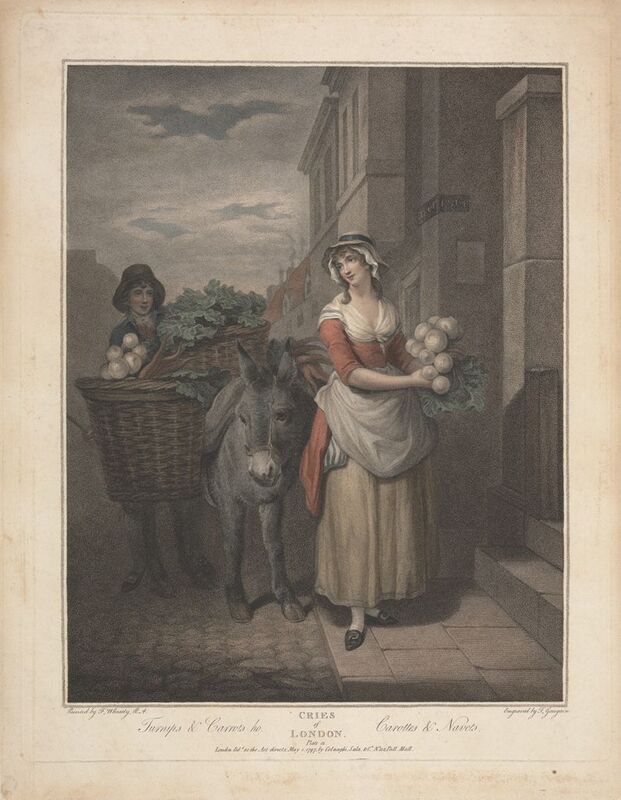
Thomas Gaugain (1748-1812) after Francis Wheatley (1747-1801). Turnips and Carrots Ho, 1797. Color printed etching. London: Colnaghi. Yale Center for British Art, Paul Mellon Collection, B2001.2.1691
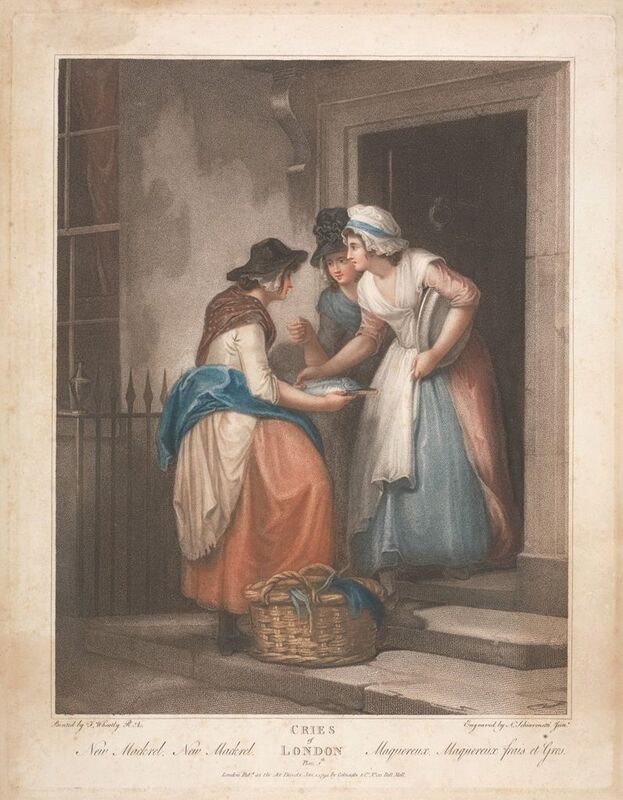
Niccoló Schiavonetti (1771-1813) after Francis Wheatley (1747-1801). New Mackrel, New Mackrel, 1795. Color printed etching. London: Colnaghi. Yale Center for British Art, Paul Mellon Center, B1974.12.6
In the late 1790s the portrait and genre painter Francis Wheatley exhibited fourteen paintings of London street vendors at the Royal Academy. Each shows an encounter between a tradesperson and customer, rather than depicting the vendors as isolated figures crying their wares. Thirteen of the paintings were published as stipple engravings by Colnaghi between 1793 and 1797 under the collective title The Itinerant Trades of London. The prints were extremely popular and enabled Wheatley to liquidate his enormous debts. They were reprinted so frequently that by 1812 the copper plates were completely worn down and had to be re-engraved.
The prints, engraved in stipple, sold for 7s 6d each (plain), and colored prints cost 15 shillings—cheaper than engravings, but significant purchases for the middle-class market to whom they primarily appealed. Rather than being stored in portfolios by collectors, as prints often were during the period, they were what was then termed furniture prints, which typically would be displayed in homes in fashionable black and gold frames.
The prints may have reassured their owners that the streets of London were not as hazardous as they feared. Like their clientele, Wheatley’s vendors are remarkably elegant and well-dressed, a feature that did not go unremarked by his contemporaries. The painter Edward Edwards complained that “the women are dressed with great smartness, but little propriety, better suited to the fantastic taste of an Italian opera stage than to the streets of London,” echoing Hogarth’s earlier visual critique of Laroon’s elegant criers and his distaste for Continental culture.
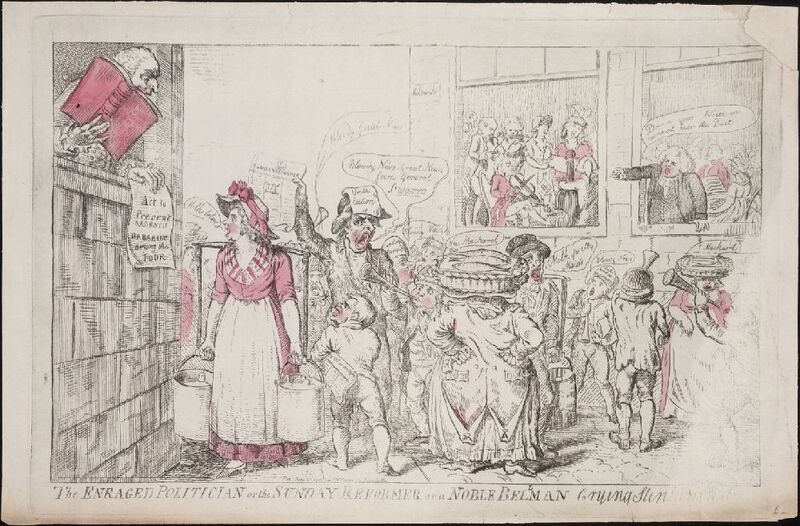
Isaac Cruikshank (1764–1811)
The Enraged Politician, or, The Sunday Reformer, or, A Noble Belman Crying Stinking Fish, 1799
Etching
London: S.W. Fores
The Lewis Walpole Library, 799.06.25.01+ Impression 1
William Hogarth’s The Enraged Musician was widely circulated in Europe, stimulating pirated versions and allusions in art and literature. Isaac Cruikshank’s choice of the engraving as a reference point for his caricature The Enraged Politician, published more than fifty years later, in 1799, shows how embedded Hogarth’s image had become in visual culture. The caricature satirizes the motion proposed in Parliament by Lord Belgrave (pictured at the window at left) to increase the ineffectual penalties for Sunday trading and ban the sale of newspapers on that day. Belgrave and fellow Christian evangelicals argued that the cacophony of vendors’ cries disturbed their Sabbath devotions. The bill was defeated. The selling of milk and mackerel was always permitted on Sundays, however, due to their perishability. A reduced version of Cruikshank’s engraving was published in Weimar in the same year in the journal Paris und London.
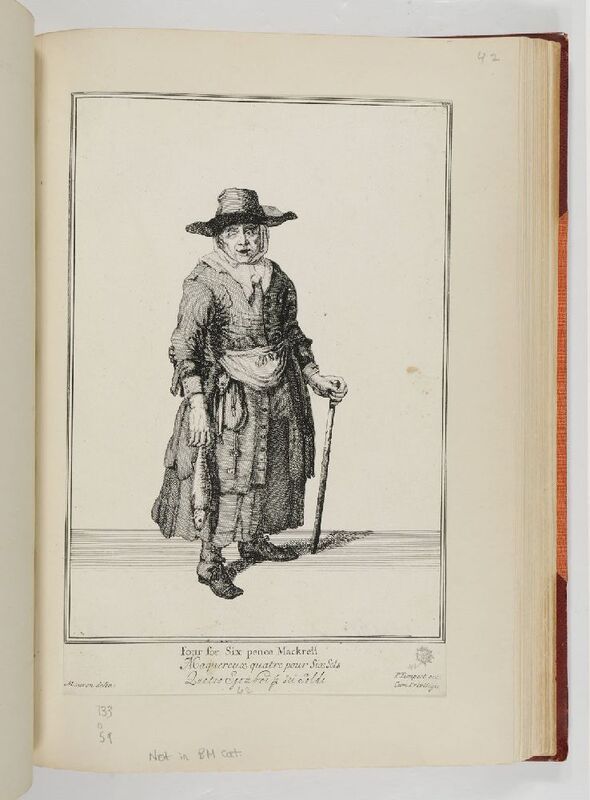
Pierce Tempest (1653–1717) after Marcellus Laroon (1653–1702)
Cryes of the City of London Drawne after the Life, 1733
Bound volume with 74 engravings
London: Henry Overton
The Lewis Walpole Library, Quarto 75 L328 733
This is a bound copy of the Cryes of the City of London Drawne after the Life, the series of seventy-four images engraved and published by Pierce Tempest after designs drawn by the London-based Dutch artist Marcellus Laroon. A single engraving from the publication, which depicts a milk vendor, is displayed on the adjacent wall. Depictions of vendors in the Cries genre tended to be stereotypical. The seller of fish (or so-called fishwife) was typically presented as an older, unrefined woman, fond of alcohol, promiscuous, and foul-mouthed. “Billingsgate,” which referred to the location of the market where fishwives bought their supplies, was slang for coarse speech in the eighteenth century. Female vendors freely ranging through the streets of London were perceived as threats to male-dominated commerce and patriarchal ideas of women’s behavior, and an element of anxiety underlay the mocking stereotypes.
Paul Sandby (1731–1809)
Twelve London Cries, Done from the Life, 1760
Fascicle with 12 etchings
London: F. Vivarez and P. Sandby
The Lewis Walpole Library, Quarto 75 Sa5 760
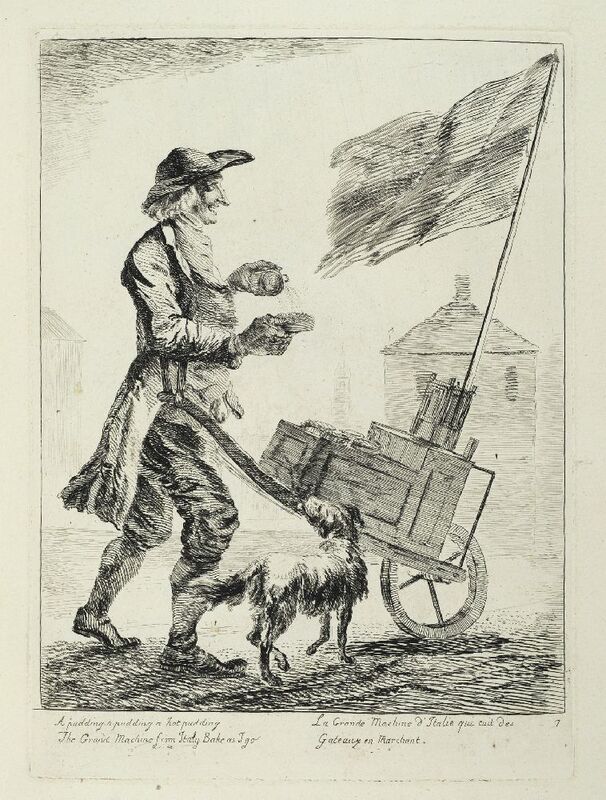
Shown: A Pudding A Pudding A Hot Pudding, the Grand Machine from Italy, Bake as I Go
In 1760 the British watercolorist and printmaker Paul Sandby issued the first part of Twelve London Cries, Done from the Life, consisting of his etchings. Each print represented a street vendor and was based on a watercolor drawing Sandby allegedly made on the spot. The artist intended to publish them in six parts, totaling seventy-two etchings, but he abandoned the scheme after the first part. Many drawings have survived, including the two exhibited here, which suggests that if Sandby had brought his series to completion it would have been a finely calibrated taxonomy of the metropolitan poor.
This vendor is shown sprinkling sugar or spice onto a hot pudding made in the “grand machine from Italy,” presumably a type of oven sitting on a wheelbarrow. Portable ovens, typically ceramic, were known from the medieval period. A wide range of baked goods was sold on urban streets in Britain, including hot gingerbread, cakes, and muffins that were sweetened with sugar produced by enslaved labor in the Caribbean and consumed by rich and poor alike. It is unclear whether the vendor was Italian. Small enclaves of immigrants from Italy lived in London at the time when Sandby was engraving his Cries. Later arrivals introduced ice cream to an eager British public, announced by the distinctive cry of “Hokey Pokey.”
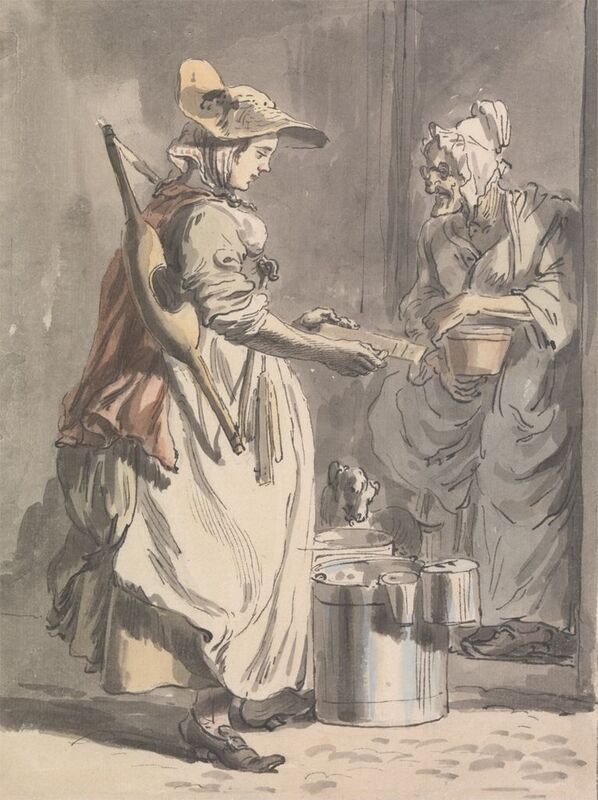
Paul Sandby (1731-1809). London Cries: A Milkmaid, c.1759. Waercolor, pen and brown ink. Yale Center for British Art, Paul Mellon Center, B1975.3.209
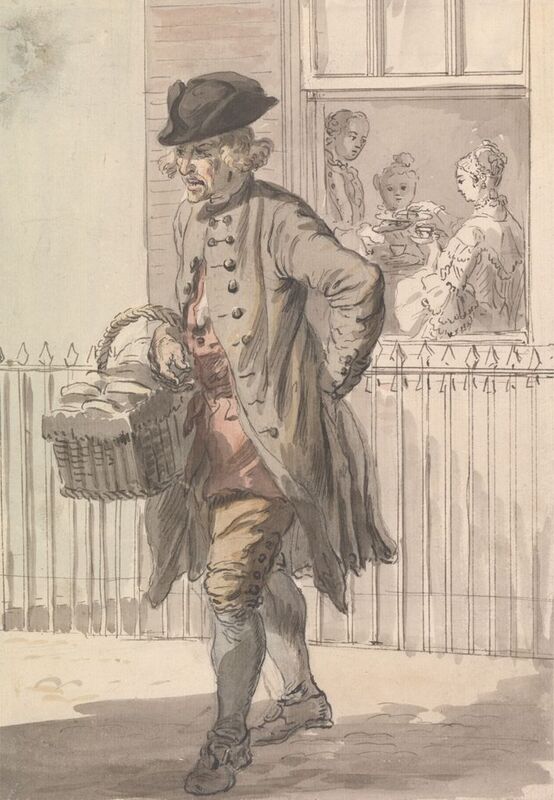
Paul Sandby (1731-1809). London Cries: A Muffin Man, c.1759. Waercolor, pen and brown ink. Yale Center for British Art, Paul Mellon Center, B1975.3.205
Sandby depicted this milkmaid selling at a house. She holds a tally stick, on which she would have recorded sales and other financial transactions by carving notches into the wood. Her customers likely paid her once a week for the milk. Two containers of milk rest on the ground, attracting the attention of a thirsty dog. She would have carried the containers suspended from the device she wears on her back.
Sandby’s muffin man carries his wares in a basket on his arm. He presumably has just left a customer’s house; the affluent family is shown drinking tea and, presumably, eating the muffins—the flatbreads known in the United States today as English muffins, rather than the cakelike muffins more widely sold today. The English muffin has often been confused with the crumpet, but the latter has holes in the top, whereas the muffin has them inside.