Street Life: The “Cries” in British Visual Culture, 1711-1877
The Transnational Cry
Food is a fundamental necessity for life as well as a source of pleasure, and since antiquity food vendors have been depicted in many cultures throughout the world, often situated within pictorial schemes that record social hierarchies. This section of the exhibition features examples of Cries made in the Americas, the Caribbean, India, and Macau. With the possible exception of the images of vendors in Lima, Peru, attributed to Pancho (Francisco) Fierro, these representations were created by artists with prior knowledge of European prototypes. It is challenging to determine whether they depicted their subjects accurately or were drawing on established stereotypes, but the artists in question—Isaac Mendes Belisario, Agostino Brunias, Nicolino Calyo, George Chinnery, and Balthazar Solvyns—all lived for long periods in the places that they depicted, and they had the opportunity to observe their subjects at close hand. Belisario and Solvyns made their own prints, rather than passing drawings over to a professional engraver as Brunias did, and their images seem to have the immediacy of first-hand observation.
The Cries genre related closely to other eighteenth- and nineteenth-century publication categories, including the costume book and ethnological treatise. Distinct from fashion-plate publications, costume books typically consisted of depictions of occupational groups, detailing the customs and working practices of their subjects. Many of the books and print series published in Britain depicted exotic cultural groups, typically presenting them as objects of curiosity, though some focused on local subject matter, stressing the difference between the dress and customs of the British and those of other nations. Ethnology—the so-called science of the human races—was evolving simultaneously. It was accompanied by publications that documented the facial characteristics of nonwhite peoples, stressed the superiority of Europeans, and disseminated pernicious racist beliefs.
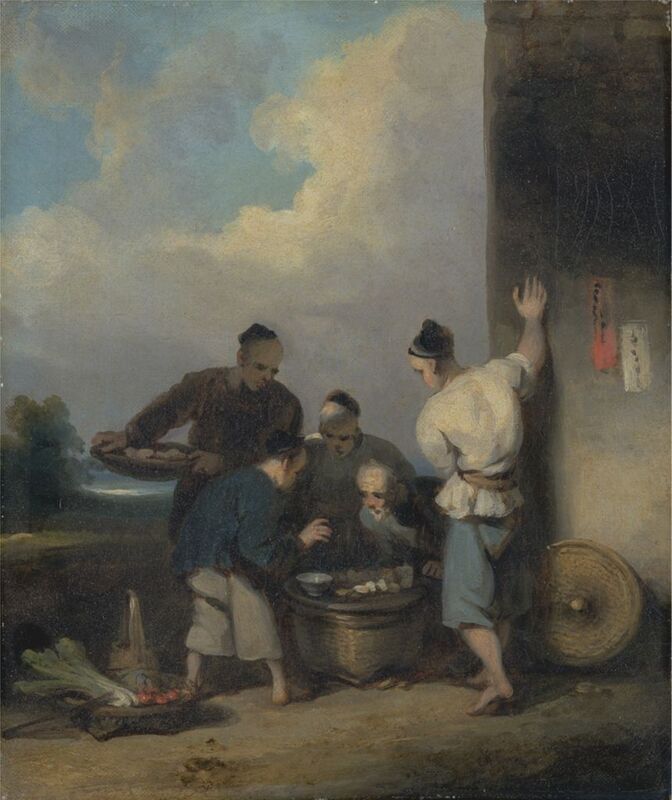
George Chinnery (1774–1852)
Men Round the Food Vendor’s Stall, after 1825
Oil on canvas
Yale Center for British Art, Paul Mellon Collection, B1981.25.99
The British portrait and landscape painter George Chinnery had an itinerant and eventful career. In 1802 he traveled to India, where he lived, at various times, in Madras (Chennai), Calcutta (Kolkata), and Dacca (Dhaka), and enjoyed a successful practice as a portraitist. Chinnery was not good at financial management, however, and to escape his debtors he fled to Macau, which was then under Portuguese control. He remained there until his death in 1852, making occasional trips to Canton (Guangzhou), Whampoa (Huangpu), and Hong Kong.
A brilliant, compulsive, and inquisitive draughtsman, Chinnery made numerous sketches of everyday life, vividly documenting laborers, boatmen and women, gamblers, animals, and markets. He also painted miniature pictures of street life, including this depiction of men eagerly eyeing a food vendor’s stall, likely in Macau. The fare on offer is apparently dumplings made in a steamer with dipping sauce in the bowl. The painting demonstrates the mobility of the genre of representations of food vendors, which proliferated in the former British Empire.
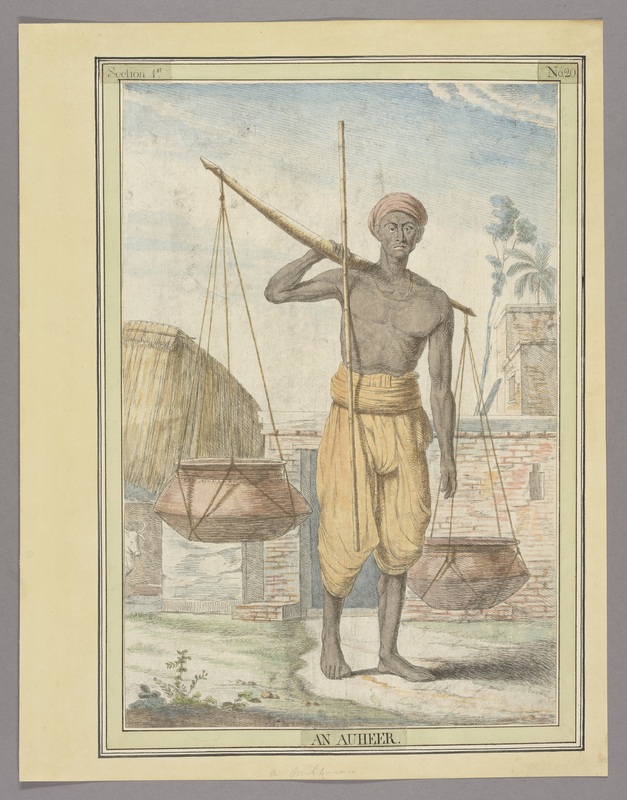
Balt. [Balthazar] Solvyns (1760–1824)
Auheer, from A Collection of Two Hundred and Fifty Coloured Etchings: Descriptive of the Manners, Customs and Dresses of the Hindoos, 1799
Etchings with watercolor
Calcutta: Mirror Press
Yale Center for British Art, Paul Mellon Collection, Folio A 2010 43
In 1794, the Belgian marine painter Balthazar Solvyns announced his intention of publishing “an interesting and valuable collection of two hundred and fifty etchings … descriptive of the manners, customs & dresses, of the Natives of Bengal: particularizing every character in the different casts [sic], with the peculiar attribute [sic] of each.” The publication, which appeared in 1799—a transitional moment when the East India Company was asserting governance in Bengal—is a remarkable encyclopedia of the local caste structure, religious practices, commerce, and labor viewed through the lens of the Cries genre Solvyns had lived in Calcutta (Kolkata) since 1791 in the so-called “Black Town,” where Indians resided, rather than the recently constructed European enclave. The exhibited etching depicts an “Auhheer or Seller of Milk, Curds and Whey.”
Solvyns’s intensive documentation of everyday life and customs suggests a deep curiosity about his neighbors, though it is unclear whether his images are totally sympathetic to their subjects. His publication was a commercial failure, but a selection of his images were soon pirated by the London publisher Edward Orme, who published them as The Costume of Hindostan in 1807. Orme’s adaptations were formulaic, racist, and popular.
Unknown artist
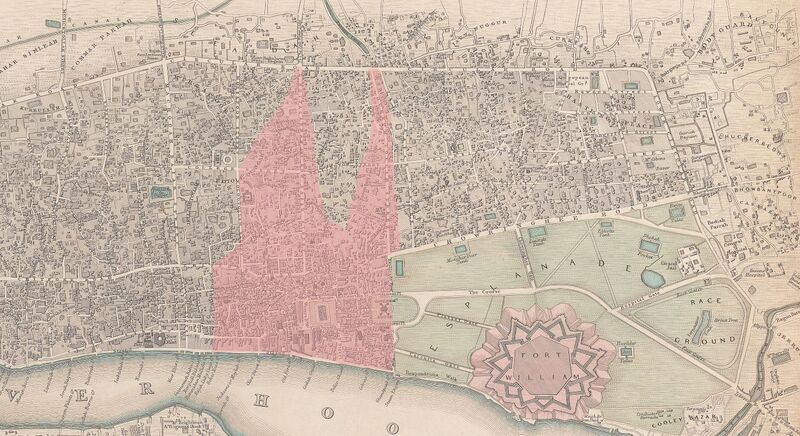
Map of Calcutta, 1842
Facsimile of original engraving (detail with superimposed tinting)
London: The Society for the Diffusion of Useful Knowledge
Beinecke Library, Yale University, BrSides Folio 2019 94
The depiction of street vendors often served as a form of city mapping in terms of showing both physical spaces and social structures. The series of 250 etchings that the Belgian artist Balthazar Solvyns published in Calcutta in 1799 provided a granular account of the presence of both indigenous inhabitants and European settlers in that city.
In 1698, the East India Company obtained rights to a large area of land in the northeast of India that consisted of three villages—Sutanuti, Kolkata, and Govindapur—which together they named Calcutta (present-day Kolkata). Sutanuti, inhabited largely by indigenous people, became known as Black Town, and Kolkata and Govindapur, where Europeans settled, were referred to jointly as White Town. In practice, there was considerable social fluidity and movement among the neighborhoods, but the notion of a white enclave was reassuring to European incomers anxious about encounters with the “natives,” as they termed them.
Solvyns settled in Black Town in 1791, spending the next few years assiduously documenting the activities of his neighbors as well as those of Europeans. The pink tinted area superimposed on this map of 1842 shows the part of Calcutta occupied by White Town during Solvyns’s period of residence in the 1790s.
Agostino Brunias (1728–1796)
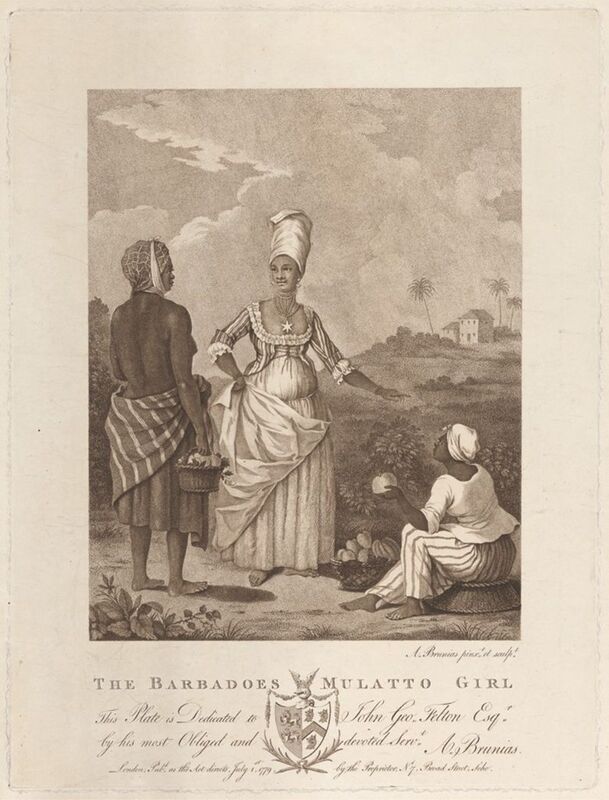
The Barbadoes Mulatto Girl, 1779
Etching and stipple engraving
London: Agostino Brunias
Yale Center for British Art, Paul Mellon Collection, B1977.14.11131
Agostino Brunias was born and trained in Rome, moved to Britain, then traveled to the Caribbean in 1764 with the brief of producing paintings that would encourage European settlement on the islands. He arrived in Barbados in 1785, and settled in Dominica, while traveling intermittently to other British-controlled islands. Brunias produced numerous paintings, some of which were published as prints in London and Paris after his return to London.
Barbados was the first English colony in the Caribbean, and as sugar cultivation rapidly increased it became a notoriously brutal slave regime. There was also a large white population, and relationships between white people and Africans were common. This engraving depicts a mixed-race woman (described as a “mulatto,” a derogatory term then used by the British) buying fruit from a Black, likely enslaved, vendor. Her assertive pose and expensive dress suggest her social superiority. Brunias would have been familiar with depictions of food vendors in Italian and British art and visual culture, and he brought a unique outsider’s perspective to his depiction of people of color on the islands.
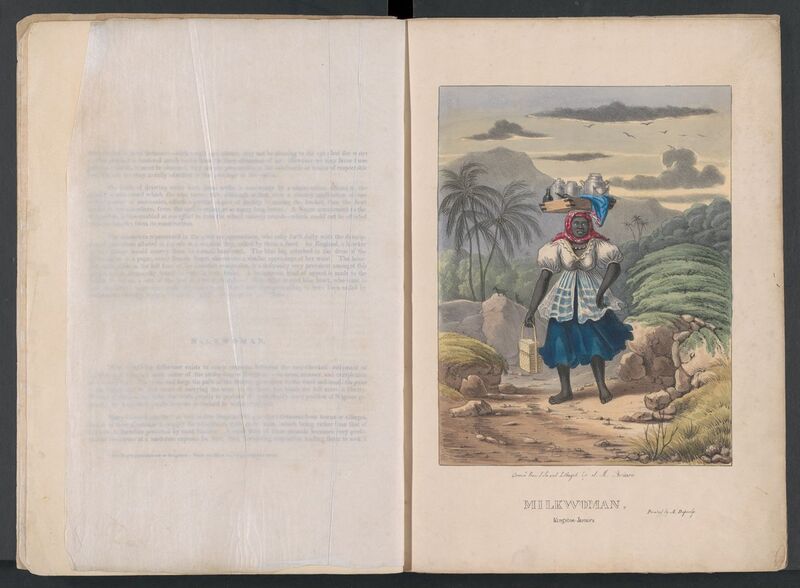
Isaac Mendes Belisario (1795–1849)
Sketches of Character: In Illustration of the Habits, Occupation, and Costume of the Negro Population in the Island of Jamaica, Part 3, 1838
Fascicle with four lithographs with watercolor and letterpress
Kingston, Jamaica: Isaac Mendes Belisario
Yale Center for British Art, Paul Mellon Collection,, Folio A 2011 24
Shown: Milkwoman
Sketches of Character is a series of twelve lithographs published in three parts made in Kingston, Jamaica, by the Jewish-Jamaican artist Isaac Belisario on the eve of the emancipation of the enslaved in British colonies in 1837–1838. Belisario adopted the Cries genre to depict the African-Jamaican masquerades performed in Kingston as well as some of the occupations of the free or soon-to-be freed Black Jamaicans. In the accompanying text (known as “letterpress”), Belisario referred to the series as his “Cries of Kingston.” He also noted that his milkmaid carries goats’ milk and “travels at a rapid rate.” He did not specify her status, but she was likely a “Free Black,” living off her rural smallholding, a sturdy, autonomous figure asserting her independence from colonial rule.
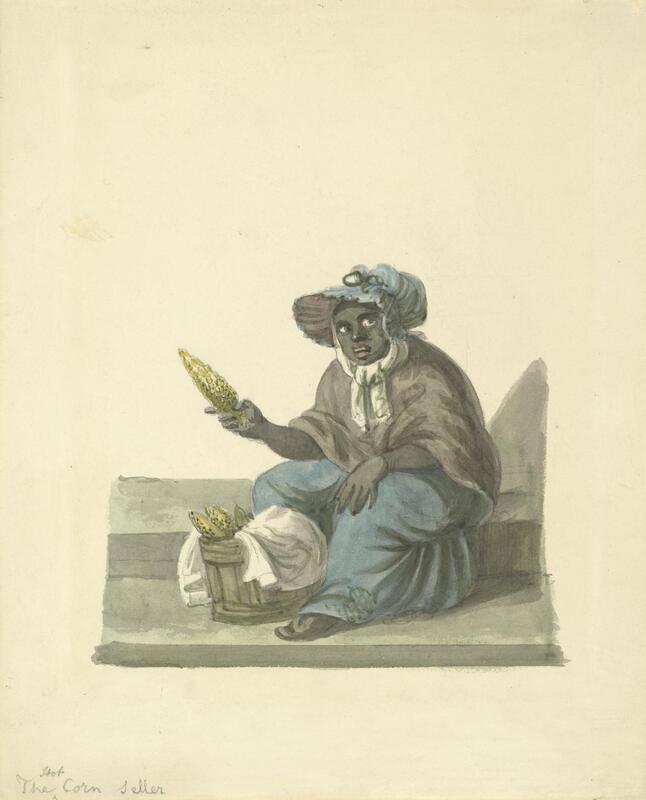
Nicolino Calyo (1799–1884). The Hot Corn Seller, c. 1840. Watercolor. Yale University Art Gallery, 2001.71.2.44
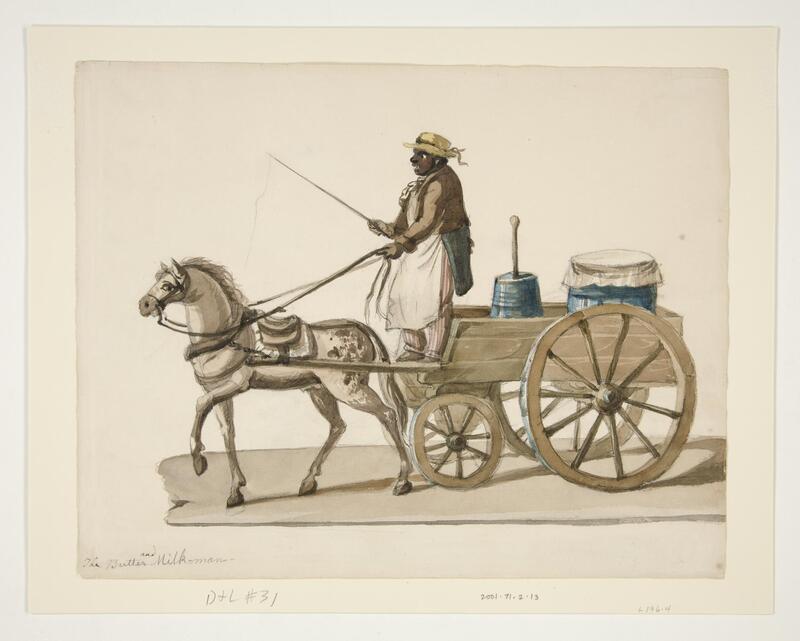
Nicolino Calyo (1799–1884). The Butter and Milk-man, c. 1840. Watercolor. Yale University Art Gallery, 2001.71.2.13
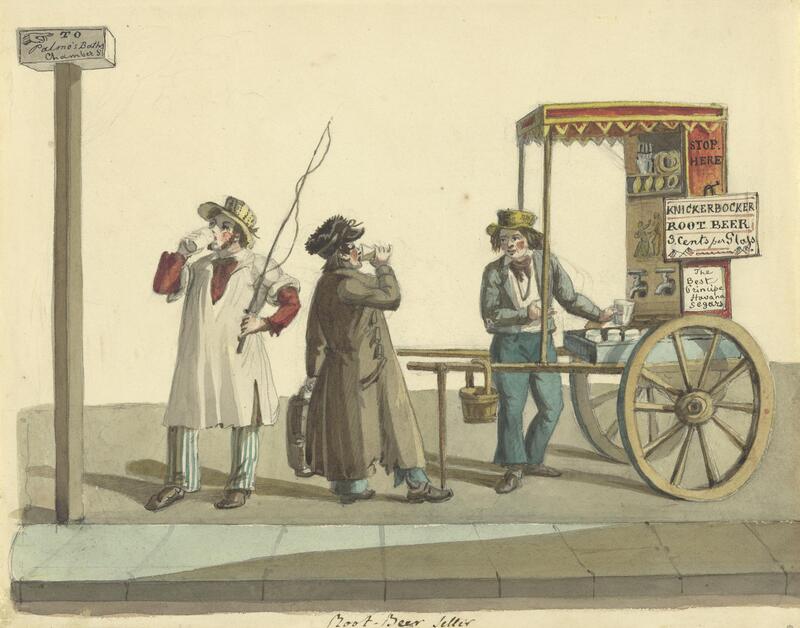
Nicolino Calyo (1799–1884). The Root-Beer Seller, c.1840. Watercolor. Yale University Art Gallery, 2001.71.2.17
Nicolino Calyo was born in Naples and emigrated to America in the early 1830s, moving first to Baltimore and subsequently settling in New York City around 1835; he also traveled in the Caribbean. He specialized in painting topographical views, and is probably best known for the spectacular series of gouaches (also published as engravings) depicting scenes from the fire that devastated New York in late 1835.
Calyo also made an extensive series of vibrant and closely observed watercolors of New York vendors, tradespeople, and street figures. These appear to be indebted to the Cries genre, which he may have first encountered in his native Italy. Many depict African-American figures, demonstrating the proliferation of free Black people and the racial diversity of Manhattan at this period as well as the wide range of street food on offer there.
He may have intended to have these watercolors engraved; in any case, multiple copies of some exist, suggesting that there was a market for these images.
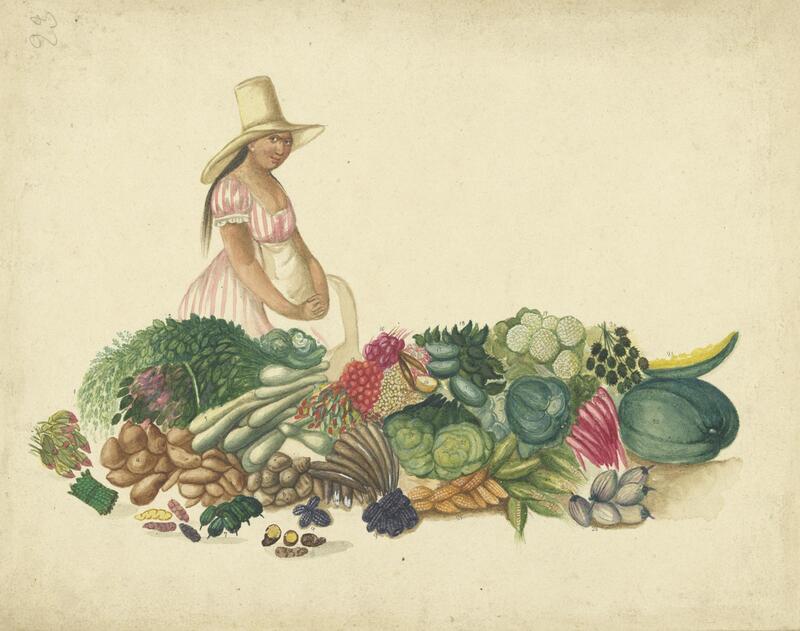
Attributed to Pancho (Francisco) Fierro (1810–1879). Woman with Fruit and Cabbage on Plaza de Lima, c. 1850. Watercolor. Yale University Art Gallery, 1967.36.8
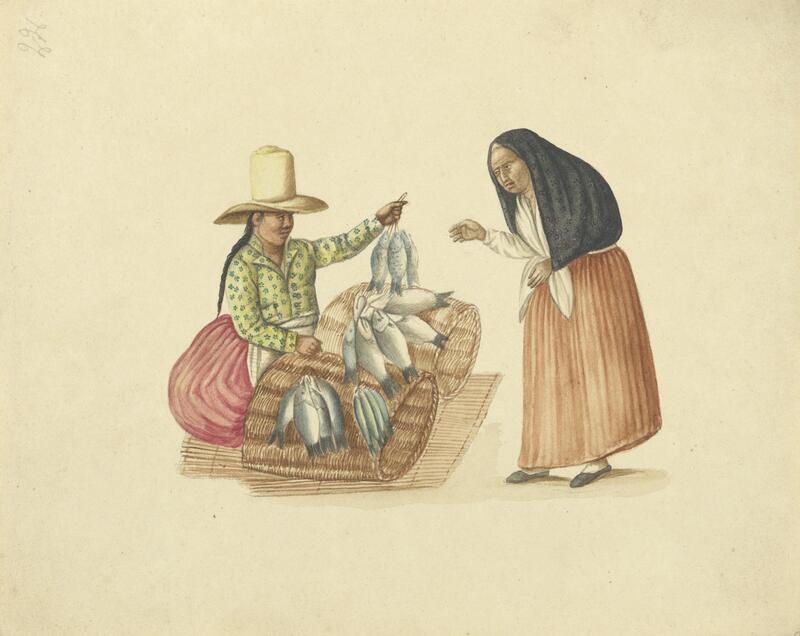
Attributed to Pancho (Francisco) Fierro (1810–1879). Fish Merchant and Indian Woman, c. 1850. Watercolor. Yale University Art Gallery, 1967.36.23
These two drawings are from a larger group in the Yale University Art Gallery collection that have been convincingly attributed to the African-Peruvian, self taught artist Pancho (Francisco) Fierro. He was the son of an enslaved woman and a Spanish army officer, and he was freed at birth. The drawings represent vendors in Lima, Peru, in the 1850s, a time when the city was being regenerated in the aftermath of the War of Independence. They demonstrate the wide array of foodstuffs that were then available. The individual fruits and vegetables in the watercolor of the vendor on Plaza de Lima are numbered and were likely described in a separate list. Pancho may have intended to publish a print of the watercolor.
The drawings appear to differentiate between ethnicities, and they may derive from the colonial genre of casta painting that represented different races and classes. Whether or not the artist also had seen European engravings of street food vendors, his vivid drawings suggest first-hand observation of street life in Lima at a critical moment in the city’s history.