Caricatures, Campagna, and Connoisseurs: Thomas Patch and the British Grand Tour in Eighteenth-Century Italy
Landscape
Like Canaletto and his nephew, Bernardo Bellotto, in Venice, and Giovanni Paolo Panini in Rome, Thomas Patch painted Italian landscapes. When he was in Rome, Patch painted local views of Tivoli and Terme. In Florence he was frequently “a-bridge painting,” which he found tediously repetitive, although painting topographical views for Grand Tourists was among his most lucrative activities.
Thomas Patch
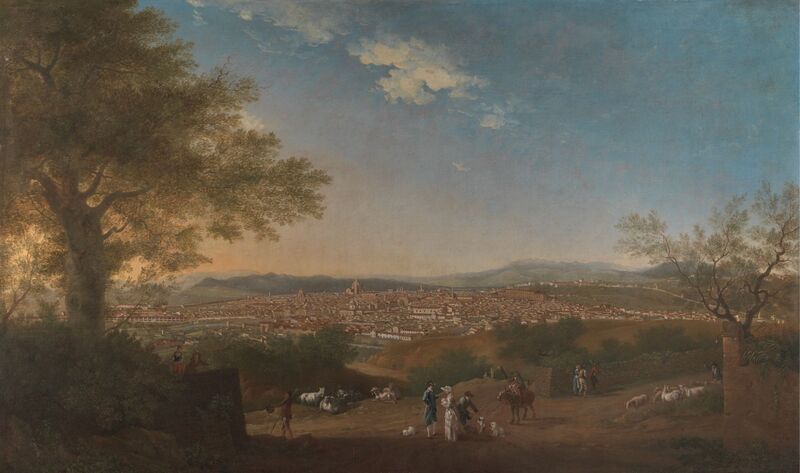
A Panoramic View of Florence from Bellosguardo
Oil on canvas
Published 1775
B1973.1.45
Yale Center for British Art, Paul Mellon Collection
-
Patch painted a number of panoramic views from Bellosguardo. Apart from this canvas, others are in the collection of the Cassa di Risparmio di Firenze; the Royal Collection Trust, London; and the Royal Albert Memorial Museum in Exeter.
Bellosguardo is a hamlet approximately a mile southwest of Florence, and it commands panoramic views of the city. Patch’s accurate topography shows (from left to right) S. Lorenzo, the Duomo, Orsanmichele, Palazzo Gran Duca (now Palazzo Vecchio), Sta Croce, Sta Spirito, and Palazzo Pitti. The foreground, however, is less accurate, as he frames the view with trees and staffage in a Claudian manner.
Thomas Patch
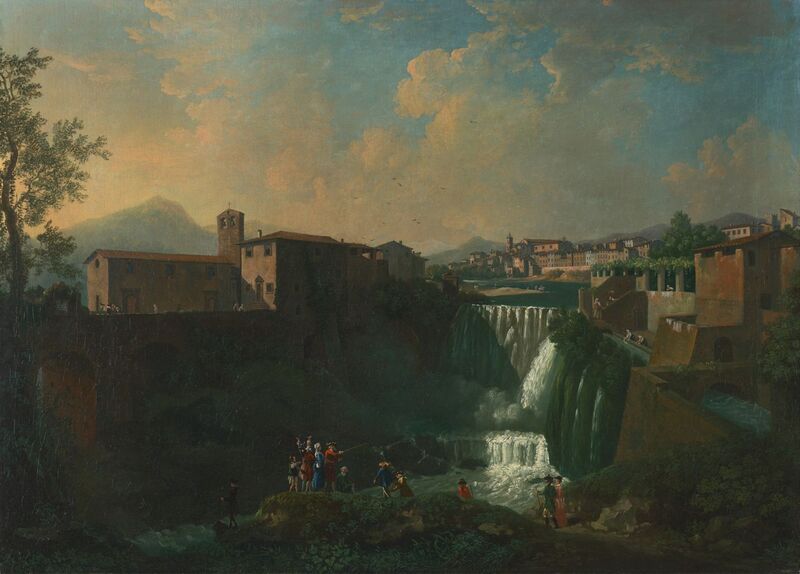
A View of Tivoli
Oil on canvas
Published between 1750 and 1754
B1973.1.46
Yale Center for British Art, Paul Mellon Collection
Tivoli is twenty miles northeast of Rome perched on the edge of the Sabine Hills. This canvas, one of several views of the location painted by Patch, shows a group of animated Grand Tourists admiring a series of falls on the River Aniene, which skirts the northern edge of the town.
Thomas Patch
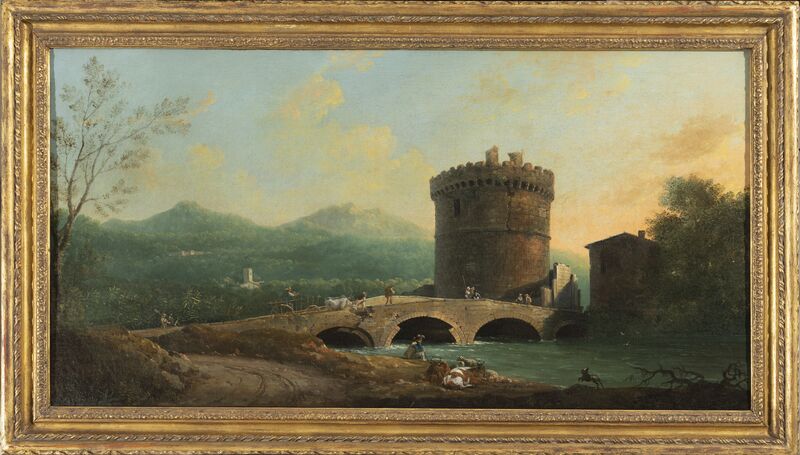
A view of the Ponte Lucano and mausoleum of the Plautius family
Oil on canvas
Published not after 1782
LWL Ptg. 102
Lewis Walpole Library
The Ponte Lucano spans the River Aniene and is situated a couple miles west of Tivoli. Beside it stands the circular tomb of the Plautius family. Both were built in the first century BCE. This canvas is one of a group of three paintings that was probably designed as a suite of overdoors for a single room. The others show the Tomb of Cecelia Metalla and the Tombs of the Horatii and Curatii, both close to the Appian Way.
Thomas Patch
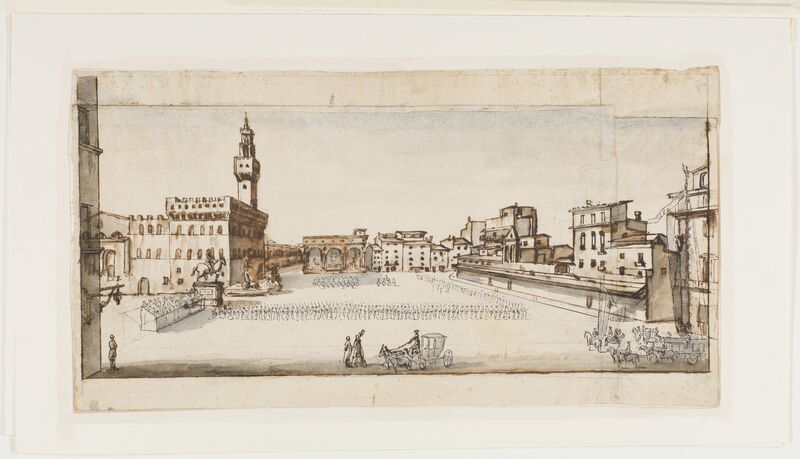
View of the Piazza del Gran Duca
Black chalk, pen and brown ink, wash and colored inks, and pencil
Published not after 1782
Drawings P294 no.1
Lewis Walpole Library
This sheet shows the Piazza del Gran Duca (now the Piazza della Signoria) looking south toward the Loggia dei Lanzi with the Palazzo Vecchio on the left. The drawing must have served as an architectural study for several topographical paintings of the piazza Patch painted in the 1760s. All of them included different groups of figures. Perhaps the best-known painting of this view is in the museum and art gallery in Plymouth, UK.