Caricatures, Campagna, and Connoisseurs: Thomas Patch and the British Grand Tour in Eighteenth-Century Italy
Caricature
Pier Leone Ghezzi had popularized caricature in Rome in the first half of the eighteenth century and, in the 1750s, when he was Patch’s British companion in the city, Sir Joshua Reynolds also painted a number of caricature groups. After Patch moved to Florence, he developed the genre in more informal caricature groups. The Lewis Walpole Library has the largest collection of the artist’s painted caricature groups.
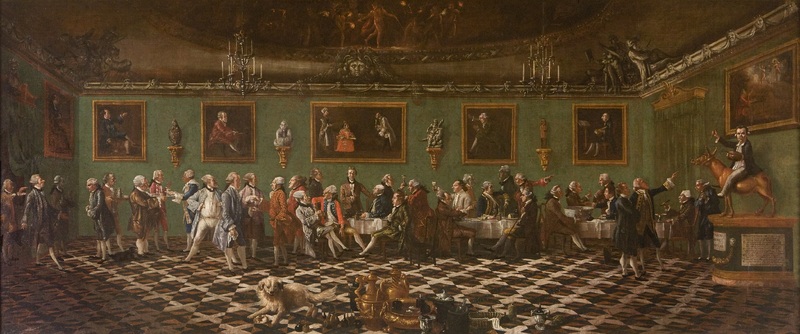
Thomas Patch
The golden asses
Oil on canvas
Published not after 1782
LWL Ptg. 133
Lewis Walpole Library
This is the largest caricature group that Patch painted, and it is known in two versions. The other, with slight variations to the architecture, is in the Devonshire Collection at Chatsworth, Derbyshire. The artist, who has given himself animal ears, holds a palette and brush and is shown riding an ass at the extreme right of the painting. The ass stands on a plinth that bears an inscription quoting Machiavelli’s Dell’ Asino d’Oro, a poem frequently equated with young, rich Grand Tourists. On the back wall, at the left, are portraits of Sir Henry Mainwaring, 4th Bt; his neighbor, George, Lord Grey (later 5th Earl of Stamford); and to the extreme right, Revd Jonathan Lipyeatt, a “bear leader” who accompanied Grand Tourists on at least four different tours of Italy. These characters appear in a pair of caricature groups commissioned by Lord Grey that are still at Dunham Massey in Cheshire.
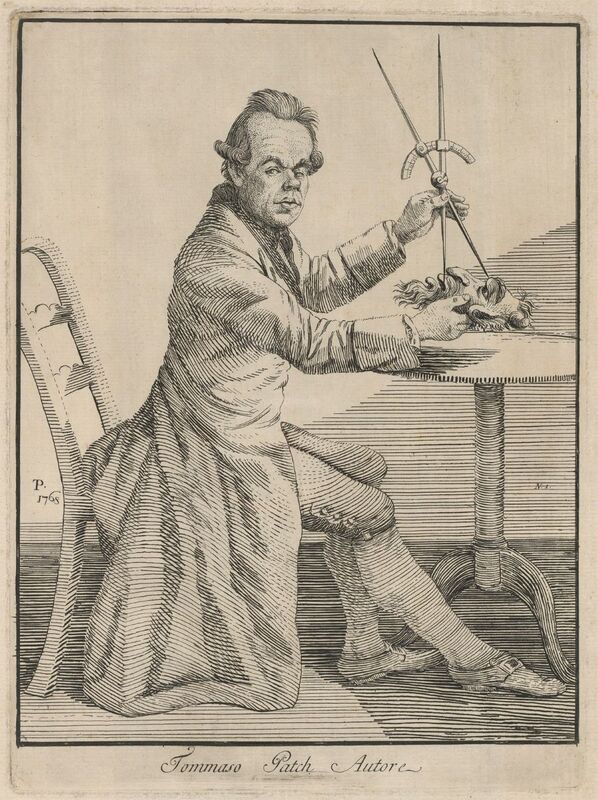
Thomas Patch
Thomaso Patch, Autore
Etching
Published 1768
B1977.14.1325
Yale Center for British Art, Paul Mellon Collection
This self-portrait is included in the volume of twenty-five full-length caricature etchings that Patch produced in 1768 and 1769. It shows the artist turning toward the beholder while he “canonizes” a satyr’s head. Patch frequently associates himself with satyrs—perhaps a reference to his own carnal instincts. A similar image reappears in a painting in one of the caricature groups in the exhibition.
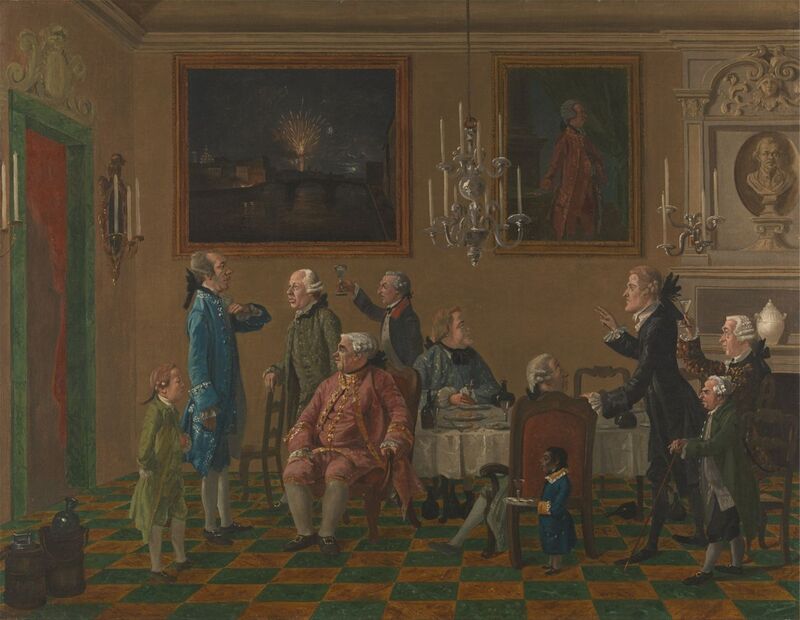
Thomas Patch
British Gentlemen at Sir Horace Mann's Home in Florence
Oil on canvas
Published between 1763 and 1765
B1976.7.187
Yale Center for British Art, Paul Mellon Collection
Sir Horace Mann, the British Resident in Florence, rented Casa Manetti, where he hosted many British visitors to the city, including at an assembly every Saturday evening. Mann is shown in the portrait to the left of the chimneypiece, and the sculpted bust over the chimneypiece represents Patch. The portly seated gentleman wearing a pink suit is John Child, 2nd Earl Tylney, who lived in Florence most of the year but wintered in Naples. A pen and ink study of Tylney is also recorded. This caricature group includes several of the figures who also appear in a companion canvas now in the Royal Albert Memorial Museum in Exeter.
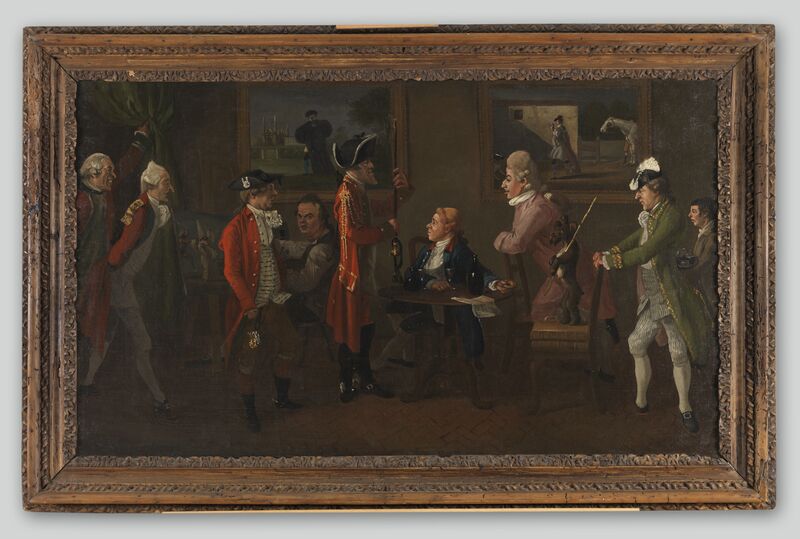
Thomas Patch
A group in the artist's studio in Florence
Oil on canvas
Published ca. 1770
LWL Ptg. 141
Lewis Walpole Library
The caricaturist Henry William Bunbury interrupted his studies at St Catherine’s College, Cambridge, to travel to Italy. The chapel of King’s College, Cambridge, is shown in the painting on the left, and the picture at right reflects the equestrian interests of his elder brother, Thomas. On Bunbury’s left, a soldier presents arms to a dog standing on its hind legs on a chair. Patch is shown at an easel painting characters from the commedia dell’arte. Other members of the group are included in Patch’s twenty-eight soft-ground etchings of caricature heads. Pen and ink studies include those of Bunbury as well as of Valentino, who is shown here entering the room on the extreme left. Both of these portrait drawings are included in this exhibition.
Thomas Patch
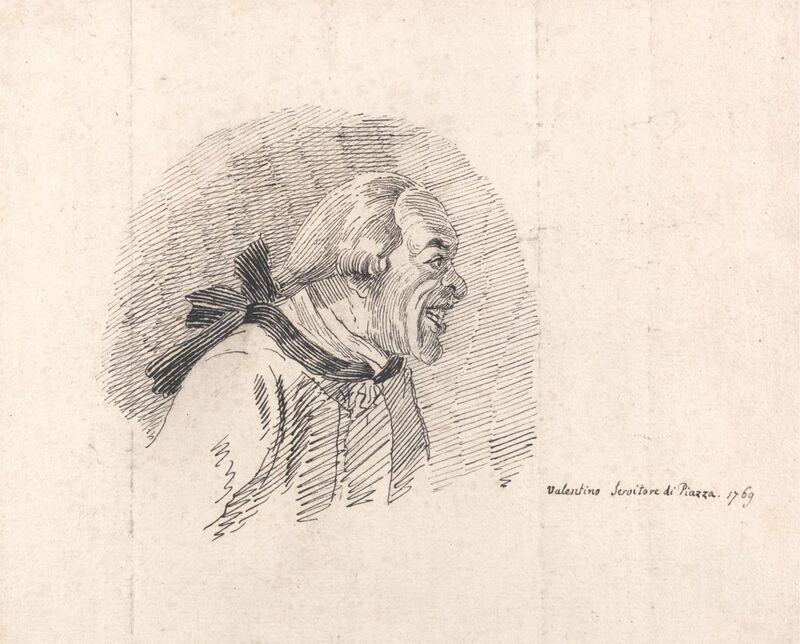
Valentino, Servitore de Piazza
Pen and ink
Published 1769
B1977.14.5321
Yale Center for British Art, Paul Mellon Collection
In this drawing’s inscription, Valentino is described as a “Servitore de Piazza,” an unofficial guide to the city who lacked the detailed knowledge of a cicerone. Valentino appears on the extreme left of the Bunbury caricature group, where he pulls back a curtain as he enters the room. This study was originally on the same sheet of paper as the pen and ink sketch of Bunbury.
Thomas Patch
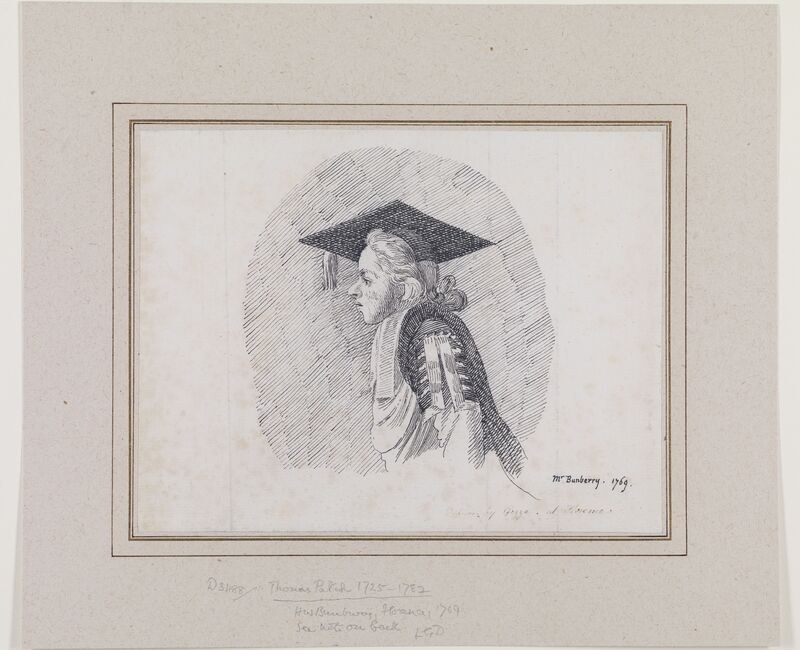
Henry William Bunbury
Pen and ink
Published 1769
Drawings P294 no.2
Lewis Walpole Library
This sketch related to the caricature group featuring Bunbury was recently acquired by the Lewis Walpole Library. The drawing shows the young Bunbury in mortarboard and academic gown looking rather anxious. In the painting, his expression is more quizzical.

Thomas Patch
A Party at Sir Horace Mann's in Florence
Oil on canvas
Published not after 1782
LWL Ptg. 128
Lewis Walpole Library
Entering the room on the left, Thomas Patch is laden with a basket filled with large volumes inscribed Vocabolario della Crusca, and he is accompanied by the anglophile Abbé Antonio Pillori. The painting includes a key that names the figures, none of whom pay any attention to Patch. Some of the group also appear amongst Patch’s engraved caricature heads. They include the short figure in the center wearing a red suit, Sir Watkin Williams Wynn, who was in Florence in October 1768; Viscount Beauchamp (later 1st Marquess of Hertford), dressed in green; and Frederick, 5th Earl of Berkeley, who wears a red waistcoat. Both Beauchamp and Berkeley were in Florence between April and August 1765. Sir Horace Mann, in red, is seated on the right, leaning on a round table.
Thomas Patch
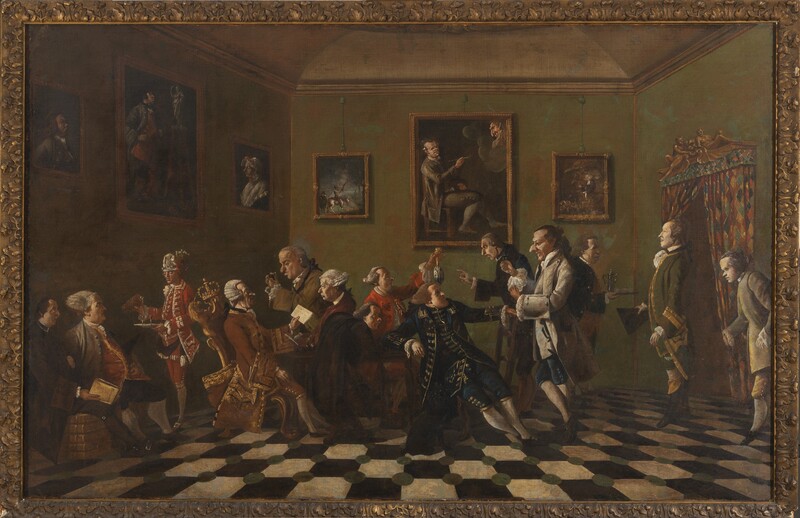
A gathering at the Casa Manetti, Florence
Oil on canvas
Published not after 1782
LWL Ptg. 125
Lewis Walpole Library
In this painting, members of the Accademia della Crusca are being hosted by Sir Horace Mann in the Casa Manetti. The Accademia, founded in 1583, is the oldest linguistic organization designed to uphold the standards of the Italian language. The figure in clerical dress on the extreme left is probably Abbé Antonio Niccolini who sits on a pile of volumes—perhaps including the fourth edition of the Vocabolario degli Accademici della Crusca published between 1729 and 1738. Niccolini also holds a book inscribed “Bertoldi,” which may be his Bertoldino e Cacasenno alla Corte del Rè Alboino, a play published in 1755 that included simultaneous Italian and English texts. At the canvas’s center, Mann sits on his vice-regal chair embellished with a crown flanked by a lion and a unicorn. The figure in blue slumped in the center of the composition is George Clavering-Cowper (later 3rd Earl Cowper), who arrived in Florence in 1759 and remained there until his death thirty years later.